
|
|
OverviewThe Lehman Neurolinguistics Lab is housed at Lehman College, City University of New York. The lab is led by Dr. Mira Goral.
Our work focuses on language processing in bilingual and multilingual healthy adults and in individuals with aphasia. Our lab has received funding from external (NIH/NIDCD, NIH/NIA) and internal (PSC-CUNY, Shuster Fellowship) funding sources. |
Learn about our lab
Featured project: Cross-linguistic examination of negation in aphasia
The video below was presented by Layla Telab at the 2021 Lehman Scholarship Day. This event highlights student-led research from Lehman College. Here, Layla gives an overview of what aphasia is and discusses a collaborative project examining negation processing in English, Spanish, Hebrew, and Arabic.
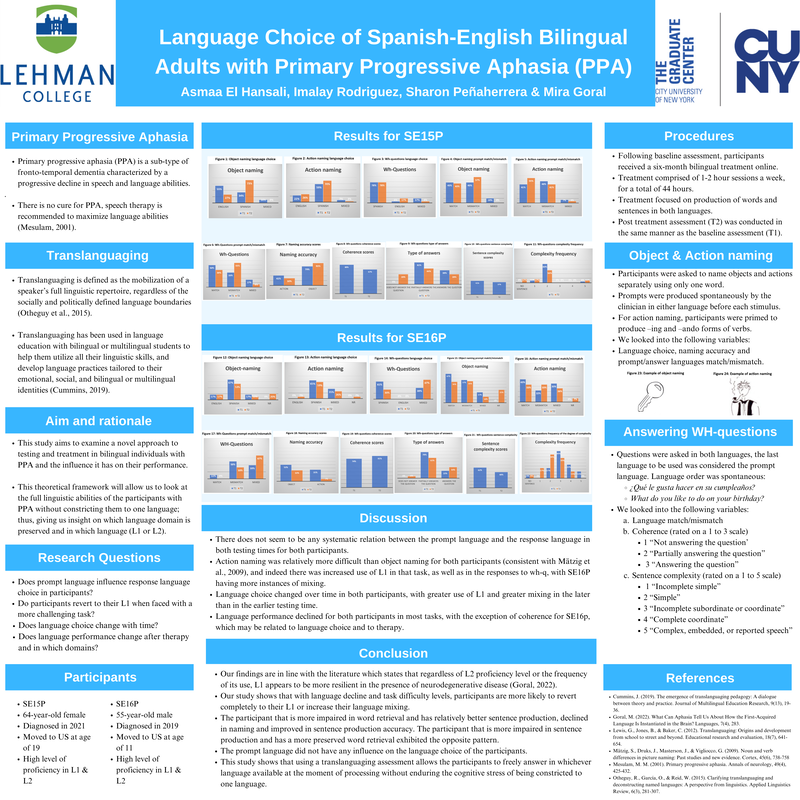
Featured Project: Multilingual Assessment in Primary Progressive Aphasia
Asmaa El Hansali, Imalay Rodriguez, Sharon Peñaherrera, & Mira Goral
This research study is part of a larger study that focuses on reducing bias and misconception associated with assessment practices of acquired language impairments (aphasia) among people who are multilingual and multicultural. This study aims to examine the bilingual patient's language profile (e.g., languages spoken, language proficiency) and language choice (single language vs. multilingual assessment sessions) and how they affect his/her performance. A novel language assessment is explored, in which multilingual people are not restricted to respond in one of their languages, rather, they are encouraged to use whichever language they wish. The project seeks to improve the quality of healthcare practices in the context of human mobility and multiculturalism in the U.S. and globally.
Featured Project: Scalar Implicatures in Italian-Speaking Individuals with CBD and bvFTD
Silvia De Marchi, Federica Biddau, Sam Alxatib, Mira Goral
This project aims to investigate the pragmatic abilities in Italian-speaking patients affected by Corticobasal Degeneration (CBD) and behavioral variant of Frontotemporal Dementia (bvFTD). In particular the research is focused on scalar implicatures, a type of pragmatic inferences that occur when using a quantifier (i.e., some, all) implies something stronger than what is explicitly stated (Horn 1972).
CBD, bvFTD, and healthy controls are administed with a comprehension task (a Truth-Value Judgment (TJVT) task using the gumball paradigm (Kursat & Degen, 2020)) and a production task (the anagram task) to assess scalar implicatures (e.g., "some of the yellow candies") and number knowledge (e.g., "five of the yellow candies").
This project seeks to expand and improve pragmatic and quantificational abilities in patients affected by neurodegenerative disorders.
CBD, bvFTD, and healthy controls are administed with a comprehension task (a Truth-Value Judgment (TJVT) task using the gumball paradigm (Kursat & Degen, 2020)) and a production task (the anagram task) to assess scalar implicatures (e.g., "some of the yellow candies") and number knowledge (e.g., "five of the yellow candies").
This project seeks to expand and improve pragmatic and quantificational abilities in patients affected by neurodegenerative disorders.
Contact us
If you are interested in participating in our studies or want to learn more about our work, please send us an email. We are also looking for student volunteers and volunteer clinicians to join our team.